
“The Picture of Dorian Gray” (1890) is the story of a beautiful young man who wishes that his portrait, not his face, would age and show the marks of sin. The wish is granted. Dorian Gray stays young and lovely while the hidden canvas grows old and ugly — and every cruelty he commits is added to the painting. Only when he finally destroys the portrait does he pay the price.
This guide has The Picture of Dorian Gray explained plainly: the story, the meaning of the portrait, the theme of beauty versus morality, and whether the book is really an advertisement for hedonism or its sharpest warning.
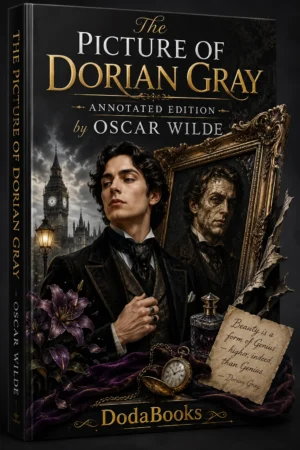
🖼️
The Picture of Dorian Gray
Oscar Wilde’s only novel — the portrait that ages, the soul that pays. Decoded: beauty, influence, and the terrible cost of living only for pleasure.
Oscar Wilde
Annotated Edition
| Author | Oscar Wilde |
| Published | 1890 (magazine), 1891 (expanded novel) |
| Genre | Gothic novel, philosophical fiction, Decadent literature |
| Setting | Fin-de-siècle Victorian London |
| Key figure | Dorian Gray, his portrait, and Lord Henry Wotton |
| Legacy | The definitive portrait (literally) of the dangerous side of aestheticism — art for art’s sake |
🖼️ What is The Picture of Dorian Gray about?
The painter Basil Hallward has fallen under the spell of a young man named Dorian Gray and finishes a portrait of him — the best work of his life. Dorian, influenced by the cynical aristocrat Lord Henry Wotton, makes a wish: that the portrait would take on the ravages of time and conscience while he stays as he is now, forever.
The wish comes true. No mark of age or sin ever touches Dorian’s face again. But he watches the portrait change: the first cruel line appears after he causes the actress Sybil Vane to commit suicide. From then on, Dorian lives for pleasure and lets the portrait carry the consequences. He hides it upstairs, and in time it grows so hideous that he must keep the room locked. In the end he stabs the painting — and in stabbing it, kills himself. The servants find an old, withered man with a knife through his heart, and the portrait restored to its former beauty.
🎨 The portrait as the soul
Wilde’s great device is making sin visible without affecting the body that commits it. The portrait is Dorian’s conscience-as-object: every lie, every ruin, every temptation accepted leaves its mark on canvas — visible to no one but himself (and to us).
This is the book’s deepest theme. Dorian Gray is not a story about being punished for beauty. It is a story about the soul’s deformities accumulating in secret while the public face stays perfect. The hidden-portrait device is the perfect Victorian image: the double life, the respectable exterior, the terrible interior where the real record is kept. It is the same anatomy of the double life that R. L. Stevenson sketched in Dr. Jekyll and Mr. Hyde, where a hidden self takes the sins and the visible self takes the credit.
👤 Beauty, youth and the fear of aging
Dorian’s wish begins in an obsession with his own beauty and a terror of losing it. The portrait frees him from age — but it also makes him a prisoner of the very thing he worshipped. He cannot change, cannot age, cannot even grow old naturally. His face stays beautiful while his life turns hideous.
Wilde is not against beauty here; he is against making beauty the whole of life. When Dorian cries that “beautiful things are only interesting because of what they conceal,” we hear the flaw in his philosophy: a life built on surface has nothing beneath it. The famous line is not a celebration but a description of the book’s tragedy — the portrait shows the surface, and the painting shows the truth.
🗣️ The danger of influence
Dorian is ruined partly by Lord Henry Wotton, who fills his head with exquisite, amoral paradoxes about pleasure and self-development. The corruptor is never the one who pays. Lord Henry stays untouched — witty, safe, growing old normally — while Dorian acts out everything Lord Henry merely recommends. For Wilde, this is the most insidious kind of evil: the epigram that makes vice sound like wisdom.
It is a warning relevant far beyond the novel: how much of our worst behavior begins as someone else’s clever phrase? The theme of a young life corrupted by a polished, older voice has kept the book permanently current.
📚 Is the book a celebration of hedonism or a warning?
The novel was scandalous on publication — reviewers assumed Wilde was preaching the very decadence he described. Reading it today, the clearer case is the opposite. Nobody in the book is happy. Dorian is miserable at the height of his freedom; Sybil dies; Basil is killed by the man he adored; Lord Henry, for all his cleverness, is emotionally hollow.
Every consequence in the story confirms the morality of the plot’s machinery: sin is recorded, guilt is real, and the soul (here made literal as paint) cannot be hidden forever. The book is best read as a gothic experiment in making the spiritual reality of moral life physically visible — and the experiment ends with the sinner destroying himself trying to erase the evidence.
❓ Frequently Asked Questions
What is The Picture of Dorian Gray about?
A beautiful young man wishes that his portrait would age instead of him. The wish comes true; his face stays youthful while his sins accumulate on the hidden canvas.
Why does the portrait age but Dorian doesn’t?
Because Dorian’s wish transfers the aging and the record of his sins to the painting. It becomes his visible conscience — the soul that the surface no longer shows.
Is the book against beauty?
No. Wilde is against making beauty the whole of life. The tragedy is a life built on surface with nothing underneath — the portrait makes that emptiness visible.
Does the portrait heal at the end?
Yes. When Dorian stabs it, the portrait is restored to its original beauty, and Dorian himself is found dead, old and withered — the ages and sins have returned to the body.
Was the book banned?
Not banned outright, but it was heavily edited for its first magazine run in 1890, and the expanded 1891 novel drew moral outrage for its treatment of pleasure and influence.
Who is Lord Henry?
An older aristocrat whose mesmerizing epigrams corrupt Dorian. He recommends the very pleasures Dorian pursues, but never pays any price for them — the true villain of the story.
🎯 Key Takeaways
- The portrait is the soul. Every sin leaves a mark on the canvas — the visible record of conscience.
- It is not a celebration of hedonism. Dorian, Sybil, Basil and even Lord Henry all pay; nobody is happy.
- Beauty without depth is emptiness. The book’s tragedy is a life built on surface alone.
- Influence can be a poison. Lord Henry is the real corruptor — words that make vice sound like wisdom.
- The double life always shows. The hidden portrait is the perfect Victorian image of the secret self.
The bottom line: The Picture of Dorian Gray shows that the soul records everything the face hides — and that the only way to escape the record is to destroy yourself.
Related reading: the hidden second self is the theme of our Jekyll and Hyde guide, and for another gothic figure whose public face hides a secret, see the analysis of The Phantom of the Opera.
📚 Read The Picture of Dorian Gray
Get The Picture of Dorian Gray — Annotated Edition
Wilde packed the novel with allusion, scandal, and gothic machinery. This annotated edition surfaces the symbolism, psychology, aestheticism and Victorian society beneath the beautiful prose.
- 📖 Complete annotated text, carefully formatted for any e-reader
- ✨ In-line notes on symbolism, aesthetics and historical context
- 🚀 Instant download, DRM-free EPUB
- 🔍 Ready to read on phone, tablet, or reader app