
“The Phantom of the Opera” (1910) is the story of Christine Daaé, a young opera singer who becomes the obsession of a masked genius living beneath the Paris Opera House. Erik — the “Phantom” — is a composer of astonishing talent whose face is a skull-like horror. He loves Christine, terrorizes the opera house to make her a star, and will stop at nothing to keep her. The novel asks what love is owed to a broken genius — and whether compassion or compulsion runs the Phantom’s obsession.
This guide has The Phantom of the Opera explained plainly: the story, who the Phantom is, the meaning of the mask, and the themes that have made this tale of music and obsession indestructible.
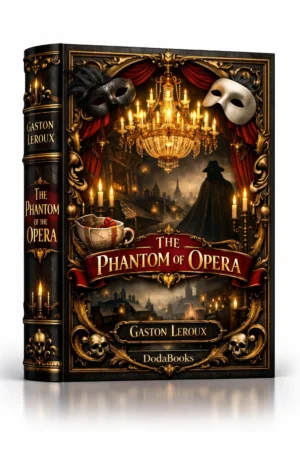
🎭
The Phantom of the Opera
Gaston Leroux’s 1910 novel beneath the Paris Opera House — decoded: the masked genius, music, obsession, and what the Phantom wants beyond the melody.
Gaston Leroux
Gothic Romance
| Author | Gaston Leroux |
| Published | 1910 (novel) |
| Genre | Gothic romance, mystery, thriller |
| Setting | The Palais Garnier opera house, Paris |
| Key figure | Erik — the Phantom — and the singer Christine Daaé |
| Legacy | Endless adaptations, including the record-breaking Andrew Lloyd Webber musical |
🎭 What is The Phantom of the Opera about?
The Paris Opera house is haunted — or so the managers, singers and dancers believe. There are mysterious demands, a missing opera box that is rented but never empty, and the tragic fall of a chandelier. Behind the legends is a man: Erik, a musical genius with a face so disfigured that no one who has seen it can bear to look at him again.
Christine Daaé sings from a voice taught to her in secret by “the Angel of Music” — who is Erik. He falls in love with her and carries her down to his hidden rooms beneath the opera house, beside a subterranean lake. Her childhood friend, the Vicomte Raoul de Chagny, rescues her. The tension is the classic triangle — and it ends not in the musical’s famous subterranean showdown alone, but in a quieter, stranger resolution involving pity, a kiss, and the Phantom’s own humanity.
🎭 Who is the Phantom, really?
Erik is a genius and a monster, both at once. He built yet another face for himself through his genius: he designed and helped construct the Palais Garnier itself, knows every trapdoor and hidden passage, and composes music that exists nowhere else. But his other face — literally, physically — is what no one can forgive him: a skull-like visage that frightens those who glimpse it.
The novel’s originality is its refusal to pick a side. Erik is genuinely terrifying — he kills, manipulates, and imprisons. But he is also desperately lonely, seeking love not for riches but for the one thing his face has denied him. Leroux dares to make the reader feel for him. The Phantom is the beautiful-mind-outcast of gothic horror: a wounded, brilliant man whom the world rejected for his appearance and who decided, if he could not be loved, he would at least be feared.
🎶 Music as the soul’s expression
For Erik, music is the language of the soul. His voice — the “Angel of Music” — is the only thing he can offer without his face getting in the way. He wants, above all, for his music to be loved; Christine is the first person to love it. The novel sets the world of visible beauty (the opera stage, makeup, costumes) against a deeper, invisible beauty: the sound Erik makes when no one can see him.
That inversion is the heart of the tale. The stage is about surfaces, and the Phantom is the voice from beneath the stage, literally — singing from the world of hidden things. When Christine sings his music, he has, for one moment, the acceptance his ugliness has always denied him. The musical’s famous songs, like the requiem in the novel, are the same idea in melody: a voiceless soul trying to be heard.
💘 Love vs. possession
Does Erik love Christine, or does he simply want to own her? Leroux keeps the question deliberately open. Erik isolates Christine in his lair, demands her love, and threatens Raoul if she refuses. Yet the novel’s climax hinges on a moment of pure compassion: Christine, seeing his despair, pities him — and Erik, moved, releases her.
The final chapters turn the Phantom from predator into a figure of almost unbearable tragedy: a creature whose entire life has been a craving for a love he believes his face has made impossible. Leroux’s answer to the question of love-versus-possession is subtle. Erik’s love only becomes real when it stops being possession — when he loves Christine enough to let her go.
🏰 Why the opera house matters
Unlike Dracula’s castle, the Phantom’s lair is a real place: the Palais Garnier, with its legends, its underground lake, and its famously secret subbasements. Leroux leaned on the building’s real architecture — the subterranean chambers below the auditorium, where water pools in the deepest levels — to make his horror feel documented.
The result is a Gothic castle turned modern: a public, glittering building with a hidden, flooded underworld beneath it. Everything above is spectacle; everything below is secret. Readers who love this layering of gothic horror and real-world setting may also enjoy Bram Stoker’s Dracula, which sets the same kind of monster-obsession inside modern London with an equally documentary feel, and Oscar Wilde’s The Picture of Dorian Gray, where a locked room on the top floor hides the truth of a beautiful man’s soul.
❓ Frequently Asked Questions
What is The Phantom of the Opera about?
A masked musical genius named Erik, living beneath the Paris Opera House, falls in love with the singer Christine Daaé and tries to make her a star. The novel is the original story behind the famous musical.
Is the Phantom a real person?
In the novel he is Erik, a disfigured genius. Leroux writes the story as if it were a true documented case, with newspaper clippings and interviews lending the legend verisimilitude.
Does Christine love Raoul or the Phantom?
She loves Raoul. Her bond with the Phantom is pity and gratitude for his music. In the end her compassion is what softens Erik and sets them free.
How does the book end?
Christine pities Erik, and he relents, letting her go to Raoul. The Phantom visits Raoul and Christine afterwards and tells them he is dying; a later epilogue confirms his death and burial.
Is the musical the same as the book?
It follows the same skeleton but compresses it. The musical is broadly inspired by Leroux’s plot; the novel has a much larger cast, more mystery detail, and a different, quieter finale.
Why is the Phantom disfigured?
The novel does not dwell on a cause; Erik says he has been this way since birth and that his mother refused to look at him. His face is his lifelong wound — the source of his genius and his pain.
🎯 Key Takeaways
- The Phantom is genius and wound in one. His face is the tragedy; his music is the beauty he can offer without it.
- It is a story about a soul beneath the stage. The opera house hides a flooded underworld — the visible and the hidden side of the same building.
- Love vs possession. Erik’s obsession only becomes real love when he lets Christine go.
- Music is the soul’s language. The only way the Phantom is free to be loved is through sound.
- It is a gothic castle in a modern city. Leroux grounded the horror in the real Palais Garnier and its underwater subbasements.
The bottom line: The Phantom of the Opera endures because it is not about a monster of the opera house at all — it is about a wounded genius who only ever wanted to be loved despite the face the world gave him.
Related reading: the monstrous lover appears again in our analysis of Dracula, and the theme of a beautiful exterior hiding a corrupted interior runs through The Picture of Dorian Gray, explained.
📚 Read The Phantom of the Opera
Get The Phantom of the Opera
The original novel is a mystery with many threads — the Persian, the managers, the clippings. A clean, well-formatted text makes the clues and the finale far easier to follow.
- 📖 Complete text, carefully formatted for any e-reader
- ✨ Crisp typography and chapter navigation
- 🚀 Instant download, DRM-free EPUB
- 🔍 Ready to read on phone, tablet, or reader app