
“The Strange Case of Dr. Jekyll and Mr. Hyde” (1886) is the classic story of the double life. A respected London doctor, Henry Jekyll, invents a potion that releases his darker half — a small, violent being he names Mr. Hyde. Hyde does everything Jekyll’s reputation will not allow him to do, and for a time the arrangement works. Then it begins to leak, and the respectable doctor discovers that the monster he thought he controlled has taken the wheel.
This guide has the Jekyll and Hyde duality explained plainly: the plot, who Hyde actually is, the Victorian “double-life” theme, and why the story is less about good versus evil than about the price of keeping the two apart.
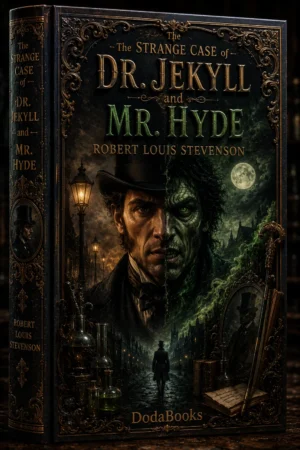
🎭
Dr. Jekyll and Mr. Hyde
Robert Louis Stevenson’s 1886 novella of the double life — decoded: the duality of human nature, Victorian masks, and why Hyde is smaller than Jekyll.
R. L. Stevenson
Gothic Novella
| Author | Robert Louis Stevenson |
| Published | 1886 (novella) |
| Genre | Gothic horror, psychological thriller |
| Setting | Victorian London |
| Key figure | Dr. Henry Jekyll and his alter ego, Mr. Edward Hyde |
| Legacy | Gave English the phrase “Jekyll and Hyde” for a split personality; the master text on the double life |
🎭 What is Jekyll and Hyde about?
The story is told from the outside. We begin with John Utterson, a cautious lawyer, who hears that his friend Dr. Jekyll has left a will passing everything to a man named Mr. Hyde — and that the same Hyde is rumored to have trampled a child at night. Utterson investigates. He finds Hyde small, loathsome, and somehow unplaceable; men feel a “disordered” disgust they cannot explain.
Then comes a murder: an elderly gentleman, Sir Danvers Carew, is beaten to death with a cane — and witnesses identify the killer as Hyde. Jekyll becomes reclusive and strange. Eventually his friend Dr. Lanyon is frightened to death by what he has seen. Only in the final document — Jekyll’s “Full Statement of the Case” — do we learn the truth: Jekyll made the potion, Hyde is his alternate self, and the two have begun to merge.
🌗 The duality of human nature
The novella is usually summarized as “good versus evil,” but Stevenson is subtler. Jekyll does not merely split himself into a good man and a bad man. He splits himself into a respectable, public self and a hidden self — and neither is purely good or purely bad.
The famous oddity is that Hyde is smaller than Jekyll. The monster is not the magnificent opposite of his creator; he is a shrunken, simian figure, as if evil were a spiteful residue rather than a grand force. Stevenson’s picture of human nature is that we are compounded of bestial and spiritual strands, and civilization is the work of keeping the bestial under control. The price of that control is that the bestial accumulates.
🏛️ Victorian respectability and the double life
The novella is a story about its own society. Victorian London prized reputation, and Jekyll is entirely built of reputation — a doctor, a philanthropist, a gentleman. Hyde is the vacation from all of it: the nights out, the cruelty, the pleasure that respectability forbids. That is why the story struck so hard. Readers in 1886 immediately understood the geography, the foggy streets, the locked doors, the “people who go to see a man every night” and the gossip that knows better than to ask.
For a society famous for its public masks — and for an Edinburgh-born writer who knew the racy side of town intimately — the novella is a confession by other means: the respectable man and the secret life are the same man. The same theme of a hidden second self runs through The Picture of Dorian Gray, where a man’s sins collect on a hidden portrait while his public face stays forever young.
🧪 Science, addiction and the potion
Stevenson calls the transformation a chemical discovery, but the mechanics read like the addiction Jekyll himself describes — the same internal struggle, the same loss of control, the ever-larger doses, the growing need. Jekyll says the drug “shook the very fortress of identity”; he begins as its master and ends as its prisoner.
The potion is also a metaphor for the illusions respectable men buy: one dose and you can be your dark self, then return to your chair, reputation intact. The novella’s horror is not Hyde. It is the discovery that the separation was always a lie — that there is no clean boundary, only a self that is one thing, whole and compounded.
🏙️ Why a monster in the city?
The Gothic novel traditionally hid its horrors in castles and ruins. Stevenson moves the horror into London — a city that is itself double: brilliant public streets and hidden alleys, gas-lit respectability and shadow. Hyde’s crimes happen in fog; Utterson’s investigations wind through “black winter mornings” and “quiet” suburban roads where the horror feels almost domestic.
The urban setting makes the story modern: the monster is no medieval beast but a man walking among us, padded-footed through the city of his own making. Readers who enjoy this blend of folk fear and modern psychology will also relish Frankenstein, where another scientist lets loose a force he cannot recall.
❓ Frequently Asked Questions
What is Dr. Jekyll and Mr. Hyde about?
A respected London doctor creates a potion that releases his darker, violent self — Mr. Hyde. At first Jekyll controls the transformation; eventually Hyde grows stronger and the two selves merge.
Is Jekyll and Hyde about split personality?
Loosely. The novella invented the popular idea of a “dual nature” splitting one person into two. Stevenson was writing about the double life and hidden desires, not clinical DID.
Why is Hyde smaller than Jekyll?
Stevenson makes the dark self a shrunken, simian figure, not Jekyll’s opposite. The detail suggests evil is a residue — the bestial stratum beneath respectability — rather than a grand power.
What does the potion represent?
It represents the illusion of the clean separation — the respectable man’s secret escape. Stevenson also makes the addiction unmistakable: growing doses, dwindling control, endless need.
Who is the hero of Jekyll and Hyde?
There is no hero. Jekyll is the guilty party; Hyde is his released shadow. The closest thing to an upright observer is the lawyer Utterson, who uncovers the truth too late.
What is the moral of Jekyll and Hyde?
That the self cannot be cleanly split between good and evil. What we suppress does not vanish — it accumulates, and the attempt to separate the two halves destroys the whole man.
🎯 Key Takeaways
- Not good-versus-evil. Jekyll splits the respectable self from the hidden self — and neither half is pure.
- Hyde is a residue. The dark half is smaller, simian, and less than his creator, not a matching demon.
- It is about Victorian masks. The double life was the era’s open secret; the novella exposed it.
- The potion is addiction. Growing doses, lost control, total dependence — the mechanics are unmistakable.
- The self is indivisible. Suppressed impulses do not vanish; the attempt to separate them destroys the whole.
The bottom line: Jekyll and Hyde warns that we are each a compound being — and that the man who tries to file his darker self away ends up serving it.
Related reading: the double life continues in our guide to The Picture of Dorian Gray, where sins collect on a hidden portrait, and the theme of a dark self released by science runs through our analysis of Frankenstein.
📚 Read Jekyll and Hyde
Get Jekyll & Hyde at DodaBooks
Stevenson’s story works by withholding — the final confession only lands if the clues before it have been noticed. A cleanly formatted text makes the trail easy to follow.
- 📖 Complete original text, carefully formatted for any e-reader
- ✨ Crisp typography and chapter navigation
- 🚀 Instant download, DRM-free EPUB
- 🔍 Ready to read on phone, tablet, or reader app