
“The King in Yellow” (1895) is the horror book that terrified H. P. Lovecraft — and the one he built part of the Cthulhu Mythos on. It is a collection of ten short stories by the American writer Robert W. Chambers, and the first four are among the most influential weird tales ever written. Their subject is a play. A play with two acts, published in Paris, that nobody can finish reading without going mad.
This is a clear guide to the book and the mythology around it: what “The King in Yellow” actually is, why readers are supposed to lose their minds over it, what the Yellow Sign means, what Carcosa is, and how the collection shaped Lovecraft — and later shows like True Detective.
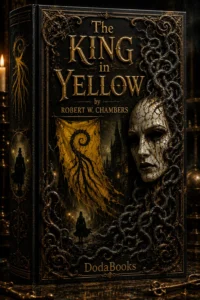
🖤
The King in Yellow
The 1895 story collection that made a forbidden play into the engine of cosmic horror — decoded: the play, the sign, Carcosa, and the myth that outlived its author.
Robert W. Chambers
Weird Fiction
| Author | Robert W. Chambers |
| Published | 1895 (collection of ten stories) |
| Genre | Weird fiction, gothic romance, early cosmic horror |
| Structure | Four connected weird tales + six stories of romance and Paris life |
| Key elements | The forbidden play, the Yellow Sign, Carcosa, Hastur |
| Legacy | Named by Lovecraft as an influence; seeded the Cthulhu Mythos |
🎭 What is The King in Yellow about?
At the simplest level, the book is a collection of loosely connected stories. But the reason it matters is the invention at its centre: a fictional play, also called The King in Yellow, which appears in the background of the first four tales.
The play itself is never shown to the reader. We only hear about what it does to people. Act I leaves a reader disturbed but alive. Act II — nobody survives with their mind intact. Characters who read it become obsessed, detached, or violently insane; some begin to speak in strange dialects, others follow unseen figures to their deaths.
The collection builds its mythology through the details characters drop: the city of Carcosa, twin suns above a lake, the name of the King himself, and the Yellow Sign — a mark which, once it is known, seems to summon its bearers toward harm.
📚 The strange structure of the collection
Chambers arranged his book in two halves. The first four stories — “The Repairer of Reputations,” “The Mask,” “In the Court of the Dragon,” and “The Yellow Sign” — belong to the weird tradition and share the King in Yellow legend. The remaining six are lighter stories of romance and Parisian life with no supernatural content.
That division matters for readers today. The fame of The King in Yellow rests almost entirely on those four stories, and most modern editions still include the full ten. The structure also tells you something about 1895 publishing: a single volume could hold both a horror experiment and a conventional romance, aimed at a broad audience.
📖 The genius of the hidden play
The most influential thing about the collection is how Chambers never shows us the play. The horror is entirely second-hand. Readers encounter people who have been changed by the text, and imagine the text for themselves.
This is the “dangerous book” trope at its purest, and it is exactly what Lovecraft would borrow a decade later for his fictional Necronomicon. A page that frightens merely by being described becomes more frightening than any page that could be written. The forbidden document is scarier empty than filled.
Chambers does something subtler too: he mixes the fictional play into a recognisable modern world. In “The Repairer of Reputations,” an ordinary-looking America is quietly ruled by printed material that warps how people see reality — an idea that still feels alive in an age of media contagion.
“Along the shore the cloud waves break, / The twin suns sink behind the lake, / The shadows lengthen / In Carcosa.”
👑 Who is the King in Yellow?
There is no single answer, and the ambiguity is the point. In the stories, the King is a wearer of a tattered robe and a pallid mask — an entity linked to Carcosa, to strange stars, and to the Yellow Sign. He is less a character than a presence that the broken play makes real.
Later writers gave the King more form. In the Cthulhu Mythos tradition built by Lovecraft and expanded by August Derleth, the King became entangled with Hastur — a title or entity that Derleth elevated into a Mythos god. The strands are loose on purpose; the myth feels ancient precisely because nobody can pin it down.
🟡 What is the Yellow Sign?
The Yellow Sign appears in “The Yellow Sign” — the collection’s most famous story — and becomes the collection’s emblem. In the story, the sign is a symbol connected to the King, and possession of it marks you as his. Characters who carry or even glimpse it are drawn toward a terrible meeting.
What it represents: knowledge that looks like a decoration but is actually a claim — exposure, conscription, doom. Where it appears: in “The Yellow Sign” as a mark a woman has tattooed or worn, and in the wider legend as the badge of those who have read the play.
Like R’lyeh in Lovecraft’s world, the sign works as a small, portable piece of the larger mythology — a detail you can name and repeat, which is why it survived.
🏛️ The fin-de-siècle fear beneath the fantasy
The book appeared in 1895, at the height of European avant-garde anxiety about art, audience and decay. The horror of the play is really the horror of influence: that a beautiful thing can pass a boundary, enter ordinary life, and change it irreversibly.
There is also a recognisable anxiety about the crowd and the city. Characters move through nervous, over-stimulated worlds of artists, priests and heirs — people whose identities are already fluid and whose sanity is already borrowed. The King is less an invader from space than a pressure already inside the century.
🐙 Influence on Lovecraft and the Cthulhu Mythos
Lovecraft read “The King in Yellow” early and never forgot it. He listed Chambers among his formative influences, and the collection seeded several elements of the Mythos: the tone of a forbidden text, the region/dialect style, and the specific names — Hastur, the Yellow Sign, and the sense of a hidden architecture behind reality. You can see the same technique — horror delivered through documents and second-hand testimony rather than direct scenes — in our analysis of “The Call of Cthulhu”, the story that made the Mythos famous.
In “The Whisperer in Darkness,” Lovecraft mentions the Yellow Sign; in “The Call of Cthulhu” the same technique of second-hand testimony carries the horror. Later Mythos writers folded Carcosa and Hastur into the shared universe. The collection did not create the Mythos, but it supplied vocabulary, mood, and precedent for the whole project.
Note on context. Chambers himself moved on: he became a prolific writer of romance and historical fiction, and later shrugged off the weird tales as youthful work. The Mythos names outlived his own estimation of them — proof that a mythology, once launched, belongs to its readers.
📺 Why The King in Yellow keeps returning
The collection’s afterlife is extraordinary. In True Detective (2014), the character Rust Cohle references Carcosa and the King in Yellow; the show draws directly on the Chambers myth. The King has also travelled through tabletop roleplaying — the Call of Cthulhu RPG canonised the Yellow Sign and Carcosa for a generation of players.
Each generation finds the fear still works: a piece of art that rewires the person who engages with it. In an age of viral media and algorithmic suggestion, that premise is easier to believe, not harder. Readers who want another cosmic-horror ancestor can continue with William Hope Hodgson’s The House on the Borderland, a novel Lovecraft also admired.
The collection also deserves its reputation as craft: the four weird stories are short, dense and genuinely unsettling, and they reward re-reading more than many better-known horror novels.
❓ Frequently Asked Questions
What is “The King in Yellow”?
A collection of ten short stories by Robert W. Chambers, published in 1895. Its fame rests on four connected tales about a forbidden play that drives everyone who reads it mad.
What is the play inside the book about?
The play, also called The King in Yellow, is never shown. It tells of Carcosa, twin suns and a masked King; Act I unhinges readers, and Act II is said to destroy their sanity entirely.
Why does reading it drive people mad?
Because Chambers built the horror entirely from rumour. The play is described, never shown, so readers imagine a text too awful to exist — which makes it far more frightening than any real page.
What is the Yellow Sign?
A symbol connected to the King, first named in “The Yellow Sign.” Those who carry or sight it are marked — drawn toward a ruinous meeting. It survives as the emblem of the whole myth.
Is The King in Yellow connected to Cthulhu?
Indirectly. Lovecraft drew on it, and later Mythos writers absorbed its names — Hastur, Carcosa, the Yellow Sign — into the shared universe. It is a cousin and a source, not a member of the Mythos.
What is Carcosa?
Carcosa is the doomed city of the King’s mythology, presided over by twin suns. Scholars attribute its name to an 1869 story by Ambrose Bierce; Chambers borrowed and expanded it.
🎯 Key Takeaways
- The horror is second-hand. The play is never shown; described danger is scarier than shown danger.
- It invented the “dangerous book.” The Necronomicon and every cursed tome descends from this collection’s premise.
- The first four stories carry the legend. The other six are romance; almost all of the myth lives in “The Yellow Sign” and its neighbours.
- It seeded the Cthulhu Mythos. Hastur, the Yellow Sign and the hidden-architecture tone all descend from Chambers.
- It keeps being rediscovered. True Detective and the Call of Cthulhu RPG prove the premise still holds.
The bottom line: “The King in Yellow” is horror’s greatest missing object — a play we never see, whose power is that we never do.
📚 Read The King in Yellow
Get The King in Yellow at DodaBooks
Chambers’ collection rewards reading alongside its own myth — and a clean, well-formatted edition makes the strangeness easier to follow.
- 📖 Complete text, carefully formatted for any e-reader
- ✨ Crisp typography and chapter navigation
- 🚀 Instant download, DRM-free EPUB
- 🔍 Ready to read on phone, tablet, or reader app