
H. P. Lovecraft wrote “The Call of Cthulhu” in 1926 and published it in the February 1928 issue of Weird Tales. For most of his life he was an obscure Providence writer, little known beyond the pulp magazines that paid him a few dollars a story. The tale changed none of that in his lifetime. Yet close to a century later it is widely read as one of the foundational texts of modern cosmic horror — the story that gave the Cthulhu Mythos its central figure and its most recognisable statement of a worldview that had been forming in Lovecraft’s mind for over a decade.
This is not a plot summary. It is a close reading — an attempt to understand how the story works, what it is actually saying, and why it still works on readers who have long since stopped believing in sea gods. If you have ever wondered what “cosmic horror” really means, or why the sight of a squid-faced titan should frighten anyone, the answers are in the architecture of this strange, fragmented, insistently rational little story.
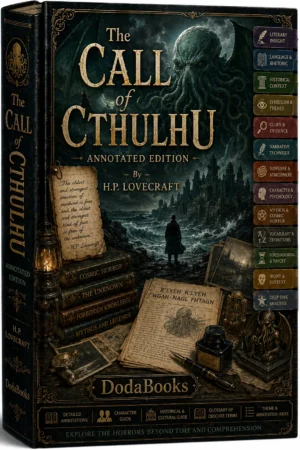
🖤
The Call of Cthulhu
The story that defined cosmic horror — a close reading of Lovecraft’s themes, symbols, characters and the mythology he created around a dreaming god in a sunken city.
H. P. Lovecraft
Literary Analysis
| Author | H. P. Lovecraft |
| Published | February 1928, Weird Tales |
| Genre | Cosmic horror, weird fiction |
| Structure | Epistolary — documents, letters and a sailor’s confession |
| Setting | Providence, Louisiana swamps, and the sunken city of R’lyeh |
| Legacy | Founded the Cthulhu Mythos; a key text of cosmic horror |
📜 The curious structure: a story that refuses to tell itself straight
The first thing a reader notices is that “The Call of Cthulhu” is not told like a normal horror story. There is no brave protagonist facing the monster in a climax. Instead the narrative is relayed — it is a story about someone assembling a story from documents. The narrator, Francis Wayland Thurston, inherits the papers of his great-uncle, George Gammell Angell, a professor of Semitic languages at Brown University who dies suddenly under circumstances that suggest he knew too much. Thurston is not a hero. He is an archivist who opens a box of papers and finds himself drawn, against his better judgment, into a truth the rest of the world resolutely ignores.
This framing device is the heart of the story’s technique, and it is easy to underestimate how radical it was. Lovecraft gives us a document dug out of a man’s estate, a bas-relief tablet carved by a doomed artist, a newspaper clipping, a sailor’s written confession in a Norwegian dialect copied by an academic friend. Each layer is one step further from the event itself. We never meet Cthulhu — not really. We meet a carving, a description, a dream, a report. The horror is always mediated, always second-hand, always just out of frame.
Why build it this way? Because Lovecraft understood something that gory horror rarely does: that uncertainty is more frightening than spectacle. A monster you see plainly is a monster you can measure, and nothing measurable is truly terrifying. By filtering the story through documents, Lovecraft keeps Cthulhu permanently half-glimpsed — a shape in the dark water, a distortion in a carving — so that the reader’s imagination does the work mere description could never do. The psychological current running beneath it, in which ordinary people ignore the monstrous rather than face it, is the same dread that William Hope Hodgson summoned in The House on the Borderland annotated edition, a novel of an isolated house menaced by a cosmic emptiness that predates Lovecraft’s and clearly shaped it. Hodgson’s work prefigured Lovecraft’s cosmic dread by more than a decade, and reading the two side by side reveals how the weird tale was already pressing toward something larger than the traditional ghost story.
🌌 Cosmos as the enemy: what cosmic horror actually means
Cosmic horror is so often mislabelled that it is worth being precise. It is not simply horror that takes place in space, and it is definitely not tentacled monsters. The term describes a specific emotional and philosophical position: the feeling that the universe is not merely indifferent to humanity but operates on a scale and according to rules that make human existence cosmically meaningless.
Lovecraft arrived at this worldview not through mysticism but through science. He was a devoted amateur astronomer and a mechanistic materialist who had read Darwin and had long abandoned religious belief. If the universe is pure matter obeying physical law, he reasoned, then humanity is an accident — a brief flicker of self-awareness on a planet that will not miss it. There is no providence, no purpose, no cosmic justice. The old consolations of religion, which placed humanity at the centre of creation, were, in Lovecraft’s eyes, self-flattering lies.
This is where “The Call of Cthulhu” differs sharply from the monstrous horror that surrounded it in the pulp magazines. Lovecraft’s contemporaries wrote about devils and goblins and creatures that were evil in a recognisably human way — creatures that hated God and wanted to eat souls, which at least implies that souls and God matter. Lovecraft wrote about something colder. When Thurston finally understands the truth, it is not that the universe is ruled by a hostile power. It is something far worse: that the human race is an “insignificant” accident on a planet that is itself an insignificant speck, and that the great powers of the cosmos neither know nor care that we exist.
The famous closing paragraph of the story makes this explicit. Thurston likens the place of human beings in the cosmos to that of a parasite on a floating log, or a moth in a darkened room — “feeble and disembodied” beings clinging to survival while “the blind, deaf, thoughtless and indefinable” presence of Cthulhu waits in its sunken city. That is the whole of cosmic horror in one image: not an enemy that hates you, but a reality that has never once noticed you at all.
Not an enemy that hates you, but a reality that has never once noticed you at all.
🏛️ The sleeping god and the geometry of R’lyeh
If cosmic horror is the philosophy, Cthulhu and his city are its physical expression, and Lovecraft chose his images with care. Cthulhu — “the Great Old One,” “the Dweller in the Deep,” the high priest of creeping things — is not described as a demon in the biblical sense. He is described in terms that suggest something older than good and evil. He is vast, squamous, vaguely octopoid, with a head that is “a caricature” of a human face, wings, and claws that “needed no sound to thrust forth horrific visions.” He is never fully rendered, because — as the story insists — no fully rendered description could convey him.
The city of R’lyeh is one of the story’s most audacious inventions, and the passage in which the sailor Johansen and his crew stumble upon it is among the most admired set pieces in Lovecraft’s fiction. R’lyeh is a sunken city that, when raised, defies the laws of geometry. Its buildings have no right angles; its proportions are subtly wrong; surfaces appear at impossible angles; a corridor that should be flat is “impossibly” curved. Lovecraft, who was deeply interested in the non-Euclidean mathematics that were transforming physics in his day, used R’lyeh to suggest a reality organised by rules the human mind cannot hold.
This is the true horror of the story, and it is worth dwelling on because it is so easily missed. Cthulhu is not frightening because he is big and has tentacles. He is frightening because he belongs to a category of being that operates outside the categories human reason uses to make sense of the world.
“Ph’nglui mglw’nafh Cthulhu R’lyeh wgah’nagl fhtagn” — “In his house at R’lyeh, dead Cthulhu waits dreaming.”
And the incantation resists meaning precisely to signal that it comes from a mind, or a realm, to which human meaning does not apply.
There is also a historical resonance to R’lyeh that is easy to overlook. Lovecraft was writing in the 1920s, two decades of unease in the aftermath of the First World War, in which many observers had lost confidence in the idea that European civilisation stood at the summit of history. R’lyeh rising from the sea — an ancient, alien power surfacing to annihilate a modern world that believed itself the summit of history — is a plausible image of that anxiety, whatever Lovecraft’s own intent. The story’s deep fear is not of monsters but of regression: that the clean, rational, modern world is a thin layer, and that beneath it lurk older forces that will eventually resurface and reassert their dominion.
🎭 Fiction as mythology: the making of the Cthulhu Mythos
No account of “The Call of Cthulhu” is complete without noting what it begat. Lovecraft did not invent the “Cthulhu Mythos” in a single stroke — the term itself was coined later, by other writers — but this story gave the emerging shared fictional universe its central figure and its characteristic method. Before “The Call of Cthulhu,” Lovecraft had written macabre tales, but it was here that he began to build a consistent cosmology: a pantheon of Great Old Ones, a pseudomythology scattered through the texts of dead races and forbidden books, and the idea that these beings could be referenced across stories by different authors as if they were real.
This was an extraordinarily influential move for a writer who died poor and nearly forgotten in 1937. By treating his invented gods and books as though they were attested history — complete with fictional citations, invented languages, and a fictional founder of his own science-fiction fandom in Providence — Lovecraft created a mythology that later writers could inherit and extend. Robert E. Howard, Clark Ashton Smith, and August Derleth took up the pieces; the Mythos has since been taken up by hundreds of writers, filmmakers, and game designers. Cthulhu has outgrown his creator entirely, becoming a figure of pop culture as recognisable as any monster in fiction.
It is also worth being honest about Lovecraft’s influence in a register the pulps never reached. Reading the story today, in the light of his documented racism and xenophobia, is a more complicated experience than it was for its first readers, and any serious reading must acknowledge it. The imagery of “alien” races, of foreign cults as corrupting presences, and of civilisations threatened by degenerate outsiders is entangled with Lovecraft’s own prejudices. The story’s fear of the foreign, the primitive, and the non-white is not incidental decoration; it is woven into the mythology. Reading Lovecraft well means holding two things at once: recognising the genuine power of his imagination while refusing to ignore the uglier currents that ran beneath it.
Note on context. The DodaBooks annotated edition includes a critical introduction that addresses Lovecraft’s controversial personal views directly, placing them in their historical context. It treats the story not as an endorsement but as a text worth studying with clear eyes — which is why students and serious readers can trust it.
🔍 A warning dressed as scholarship
It would be a mistake to read “The Call of Cthulhu” only as a piece of exceptional weird fiction, because Lovecraft intended it as something grander: a kind of anti-Enlightenment sermon delivered in the guise of a scholarly monograph. The story is saturated with the apparatus of rational inquiry — a professor of languages, a police inspector’s report, a sailor’s deposition, an unexpected death investigated like a mystery. Yet every rational instrument fails. The professor dies mysteriously. The inspector can only suppress what he has seen. The sailor goes mad and is killed. The archivist who assembles their story ends by begging the reader to trust him — to let the fragments be dismissed as fiction, to “leave the matter as it is.”
The message is almost the inverse of the detective story — the form Wilkie Collins helped create in the Moonstone annotated edition, which promises that diligent reason can uncover and master the truth. Lovecraft’s story shows reason uncovering a truth that cannot be mastered — one that, once known, only exposes the investigator to the same doom that claimed everyone before him. Thurston’s closing plea is a warning, not an invitation. He has learned that some doors, once opened, cannot be closed, and that the cost of knowledge may be the mind that holds it.
This is why the story has proved so durable, and why it speaks to readers long after its pulp origins. It is not really about a monster. It is about the unsettling possibility — which modern cosmology, modern physics, and modern psychology have all kept alive — that the universe is far stranger, and far less concerned with us, than we would like to believe. Lovecraft found an unusually exact image for that fear, and it has never stopped working.
📖 Key Symbols and Characters
The Cthulhu idol. What it represents: the first physical proof that something should not exist — evidence that is itself unreliable, a distortion of a nightmare. Where it appears: in the opening, the bas-relief carved by the doomed artist Wilcox, and again in the fragments of Angell’s papers.
R’lyeh. What it represents: a reality organised by rules the human mind cannot hold — the collapse of geometry, and of reason. Where it appears: in the accounts of the cult and, climactically, in Johansen’s voyage to the raised city.
The sleeping god. What it represents: power that exists beyond or beneath ordinary life, dormant and patient — the fragility of our sense of control. Where it appears: in the chant “Ph’nglui mglw’nafh Cthulhu,” in the cult’s doctrine, and in the final image of R’lyeh sinking again.
The dreams. What they represent: a level of reality that connects otherwise isolated people (artists, sailors, cultists) behind the back of rational thought. Where they appear: throughout, from Wilcox’s nightmare to the worldwide dream-disturbance that precedes the call.
Francis Wayland Thurston is the rational seeker whose curiosity leads him to a truth that cannot be mastered; he frames the whole investigation.
Johansen, the sailor, is the only witness to survive a direct encounter with Cthulhu — and only just; his written account is the story’s climax.
📖 Reading the Annotated Edition
Lovecraft packed “The Call of Cthulhu” with mythology, allusion and a deliberately fragmented structure. A plain reading leaves most of that richness buried. A good annotated edition brings it to the surface without replacing the original text.
Chapter Notes
Line-by-line historical and literary annotations that explain every reference.
Character & Mythos Maps
The Great Old Ones, forbidden books and a chronology of the dawning Mythos.
Historical Context
Lovecraft’s life, the 1920s, non-Euclidean geometry and the birth of the weird tale.
Close Readings
Thematic analysis that turns a strange cult story into a work of literary history.
❓ Frequently Asked Questions
What is “The Call of Cthulhu” about?
Francis Wayland Thurston inherits the notes of his late great-uncle, Professor George Angell, and finds evidence of a worldwide cult worshipping a colossal entity called Cthulhu, sleeping in the sunken city of R’lyeh. The more he investigates, the more he learns that the truth cannot be safely known.
What does Cthulhu represent?
Cthulhu represents humanity’s insignificance in an indifferent universe. He is not the story’s centre — he is one ancient being among many, and his existence reveals how little we know rather than how much there is to fear.
Is Cthulhu a god?
Not in a human sense. The story calls Cthulhu a Great Old One and a high priest; “god” is a convenient label for a being so far outside human moral categories. The important point is indifference — an entity that does not recognise us as important.
What is cosmic horror?
Cosmic horror is the fear of an indifferent, unknowable universe rather than of a specific monster. The horror comes from the revelation that humanity is cosmically insignificant and that the great forces of the universe neither know nor care that we exist.
Why is the story told through documents?
Lovecraft filters the story through letters, reports and a confession so the horror stays mediated and half-seen. Because we never directly observe Cthulhu, our imagination does the frightening — and uncertainty unsettles far more than direct description.
Did Lovecraft invent the Cthulhu Mythos?
This story gave the Mythos its central figure and method, though the term itself was coined later by other writers. Lovecraft created a pseudomythology that later authors such as Robert E. Howard and August Derleth inherited and extended.
🎯 Key Takeaways
- Structure defines the horror. The story is told through documents, keeping its monster permanently half-seen; uncertainty frightens more than spectacle.
- Cosmic horror is a philosophy. The fear comes from an indifferent universe, not a hostile power.
- R’lyeh expresses a collapsing worldview. Its impossible geometry stands for a reality beyond reason.
- The story is a warning, not a detective tale. Reason uncovers a truth that cannot be mastered.
- It made a mythology. This story founded the Cthulhu Mythos and defined cosmic horror.
The bottom line: “The Call of Cthulhu” endures because it is not really about a monster at all — it is about the terrifying possibility that the universe is indifferent to us.
Related reading: Lovecraft named Robert W. Chambers’ The King in Yellow as an influence — that 1895 collection pioneered the “forbidden book” formula this story made famous. See our guide to The King in Yellow for how its hidden play and the Yellow Sign shaped the Mythos.
📚 Read the Annotated Edition
Get The Call of Cthulhu — Annotated Edition
Lovecraft packed this story with allusion, invented mythology and a deliberately fractured structure. A plain text version leaves most of that richness buried.
- ✅ Chapter notes and close readings of the 1928 text
- 🗺️ Character and Mythos maps to untangle the story
- 🏛️ Historical and literary context for every reference
- 📖 DRM-free EPUB, beautifully formatted for any e-reader